



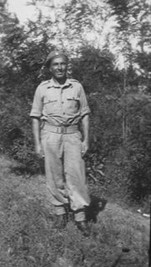
Born: February 13, 1908, in Łosińce, Drohiczyn, woj. poleskie, Poland
Died: June 25, 1973 in London, Ontario, Canada
Family: Father, Gierasim Andronowicz (born May 1882 in Poland); Mother – Uliana (Julianna) Maruszko (February 10, 1882, in Poland – December 7, 1974, in London, Ontario)
Married: He married Eufrozyna Krawczuk on May 25, 1928, in the Roman Catholic Parish Church of Suboty (Braszewicze, Drohiczyn, woj. poleskie, Poland)
Children: Włodzimierz (born 1929), Anastazja (born 1934)
Military Medals: Polish Medals: Cross of Valour, Army Medal, Commemorative Monte Cassino Cross, Cross of The Deported to Siberia; British Medals: 1939-45 Star, Italy Star, Defense Medal, War Medal 1939-1945; SPK Medals: Bronze, Silver
Fates before joining Anders Army : It was the night of February 10, 1940, when the Soviets arrested and deported Andronowicz family (Aleksy, Eufrozyna, children and Aleksy’s mother – Julianna), by cattle-car train to Nucht-Ozierski Lesopunkt – Archangielsk oblast, USSR and then to Siberia. Aleksy was assigned to cut trees in the forest. Eufrozyna was ordered to clear the snow off the railroad tracks. Later they all were sent to Uzbekistan and onto Kazakhstan.
Military history: After the amnesty was signed, they left Nucht-Ozierski Lesopunkt, USSR, on November 12, 1941, and landed in Jangigajzat, USSR. The Polish consulates in the USSR issued in-land temporary passports for those being evacuated. These had to be presented at the border crossings in order to proceed. On August 8, 1942, they travelled by train to Krasnovodsk, a port on the Caspian Sea, and embarked on a ship to cross the sea, arriving at Pahlavi, Iran, on August 20, 1942. On August 29, 1942, Aleksy enlisted in the Polish army, joining the 2nd Corps. He served as a truck driver delivering ammunition. Aleksy also served at the Battle of Monte Cassino (May 1944), where he was wounded. After WWII, he left Italy for England, arriving on September 26, 1946, where he found work and lived near the resettlement camp. He was honourably discharged from the army on June 19, 1947.
Post-War: His wife and children and his mother resided in a camp in Lusaka, Africa, for six years. Aleksy learned that his family had come from Africa and were now in England. The family lived in a temporary camp near the village of Duglinward, England. After many years of absence and separation, Aleksy was finally reunited with his family on April 24, 1948.
On April 20, 1951, they departed Southampton, England aboard the diesel motorship “M.V. Georgic” owned by Cunard White Star Ltd. They landed in Halifax on April 28, 1951, went on to Toronto and eventually settled in London, where he worked on farms in several day jobs. Later he worked on tobacco farms. After that Aleksy worked in construction, building homes on Baseline Road in London. He was very proud of his work there. Aleksy finished his working career at Westminster Hospital (now LHSC – Victoria Hospital), where he was employed in the maintenance/sanitation department. He also built his own home on Emery Street West in London, where he enjoyed the rest of his life. Aleksy joined SPK (Stowarzyszenie Polskich Kombatantów) and helped build the SPK hall and Our Lady of Czestochowa Church and often volunteered at the hall.
source of the biographical data:
Stan Skrzeszewski, Canada
based on „Pozostaną ślady dawnych dni” Książka Pamięci, Stowarzyszenie Polskich Kombatantów, Koło #2, Canada.