


The Second Polish Army Corps, also known as the Anders Army (August 1941–1947), was established on the territory of the Soviet Union. It took its name from the commanding Lieutenant General Władysław Anders. This WWII army involved over 110,000 volunteers who answered the call of Lieutenant General Władysław Anders, who was tasked with creating this army on the territory of the Soviet Union in August of 1941, soon after the German army invaded the Soviet Union. Following the German army’s attack on the USSR, Joseph Stalin announced the amnesty of the Polish POWs imprisoned in heavy labour camps in the USSR. After the Anders Army was evacuated from the USSR in 1942, it became a part of the Polish armed forces supporting the Allies in the West. The II Polish Army Corps, under the command of General Władysław Anders, was involved in the military operations in the Italian Campaign and fought and won in the January 17–May 18, 1944 Battle of Monte Cassino.
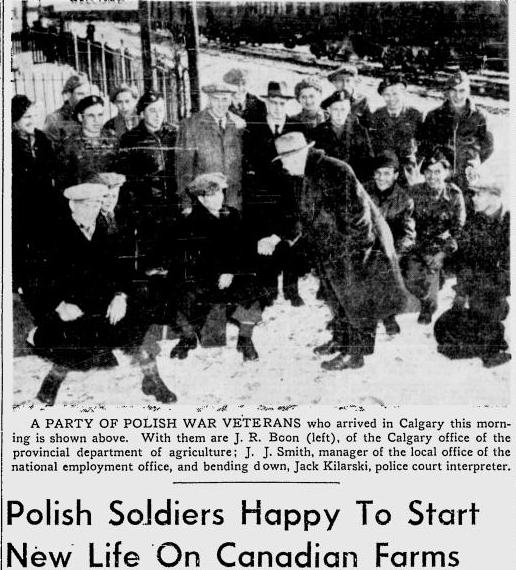
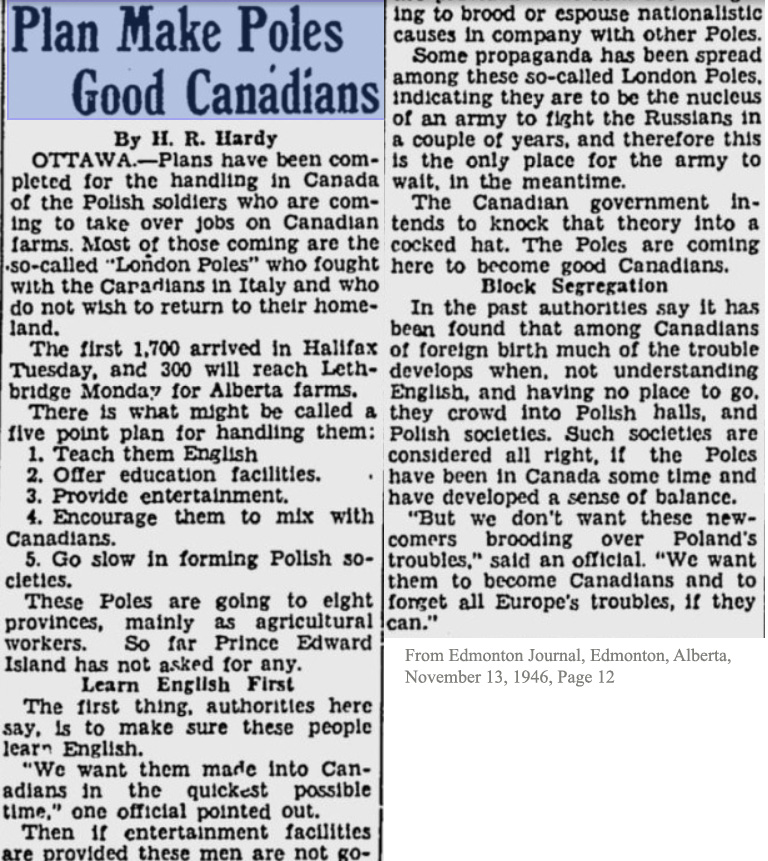
After the war, many Anders Army soldiers fearing persecution and imprisonment were unable or unwilling to return to a post-war Poland ruled by a government sympathetic to the USSR. Great Britain assisted tens of thousands of Anders Army war veterans by implementing the 1947 Polish Resettlement Corps Act, designed to find employment or help them immigrate to the British colonies. In 1946, Canada accepted 4,527 of these veterans as farm labourers under this Act. Seven hundred and fifty Polish veterans from this group came to Alberta.
AFTER THE WAR: STARTING A NEW LIFE IN CANADA
1. The 1947 Polish Resettlement and the 1920 Polish Citizenship Acts, and the Anders Army
On June 28, 1945, in Lublin, on the territory of Poland liberated by the Red Army and the 1 Polish (Berling) Army, a Polish Provisional Government of National Unity was established (Jaworska 54). This pro-Soviet and pro-communist government had the support of the Soviet Union and Joseph Stalin. On July 21, 1945, at the Potsdam Conference, the Polish Provisional Government of National Unity was recognised by Great Britain, the United States and the Soviet Union (Office of the Historian). A top secret Statement on the Polish Question affirmed, “The establishment by the British and United States Governments of diplomatic relations with the Polish Provisional Government has resulted in the withdrawal of their recognition from the former Polish Government in London, which no longer exists” (Office of the Historian).
The case of Poland, its future, the political system after the war, and its government were dealt with under cover of secrecy and without the representatives of the Polish government-in-exile.
Furthermore, a restricted document stated that “instructions were given that UMA [United Marine Executive Board] papers and minutes should cease to be sent to the officials of the former Polish Government in London” (The Office of the Historian. The USA 1124). The directives of the Big Three swiftly rendered the Polish government-in-exile and the II Polish Army Corps, reporting to it, powerless and irrelevant.
After the war, in the backdrop of the geopolitical situation of Poland and its international bearings, tens of thousands of the Polish 2 Corps ex-servicemen refused to return to Poland, led by a pro-Soviet and pro-communist government. To deal with this, Great Britain introduced the 1947 Polish Resettlement Act to help an estimated 100,000 Anders Army veterans find employment or a place to settle in the United Kingdom or one of the British colonies. Several sources in the UK outlined this in London’s The Times on May 23, 1946 (The Times 4) (The Times 4).
The pro-Soviet Polish Government of National Unity recognised the Polish Resettlement Corps as a paramilitary organisation. This government considered Polish veterans who registered in it as serving in the military service of a foreign country (The Times 4).
On May 20, 1946, The Times informed that the Polish Provisional Government of National Unity in Warsaw sent a note to London, asking for the Anders Army to be demobilised within three months. It also informed that “Groups of Polish officers sent by Warsaw would distribute questionnaires and supervise their completion and collection. By filling in and returning his form within seven days, a soldier would show himself ready to return to Poland; by not doing so within the time limit, he would lose Polish citizenship” (The Times 4).
The officers representing pro-Soviet and pro-communist Poland distributed questionnaires among the Polish 2 Corps veterans, pressing them to return to Poland. At that time, the Polish government-in-exile still existed in London. However, the Big Three at Potsdam Conference stripped this government of its power.
Mr Władysław Niewiński, one of the Anders Army veterans, stated, “We were given a letter in which the Polish authority pressed us to report to the Polish consulates and return to Poland to undergo rehabilitation. They gave us only one week to make the decision if we wanted to go back to Poland. Otherwise, we would automatically lose Polish citizenship” (Jaworska 168).
On August 23, 1946, The Times published a statement by the Polish Provisional Government of National Unity in Warsaw, “Any Polish citizen enrolling in the Corps in these circumstances would, by Polish law, lose his citizenship” (The Times 4). These measures were to take place under the 1920 Polish law on citizenship, stating, “Polish citizenship is lost by acceptance of a public office or through entering into the military service of a foreign country without the consent of the Polish Government” (The Times 3).
Furthermore, the August 23, 1946, note from the Polish Provisional Government of National Unity posted by The Times also addressed those registered or willing to register in the Polish Embassy in London (The Times 4). Those who “having completed their civilian training, wish to settle in civilian life abroad” would be treated differently, “provided they fulfilled the obligations of registering with Polish consulates, they will be afforded consular protection and, should they later decide to return home, will be given all facilities for doing so. They will thus retain their Polish citizenship” (The Times 3).
The recruitment to the Polish Resettlement Corps was to start on September 11, 1946, and 200,000 copies of the statement of the terms were to be distributed among the Polish war veterans (The Times 3).
On September 13, 1946, The Times reported that Marshal Rola-Żymierski, Minister of Defence of the Polish pro-communist government, said that “Polish soldiers joining the Polish Resettlement Corps in Britain would lose their citizenship, their rank, and all decorations they might have been awarded. They would be considered ‘individually responsible for their tragedy, resulting in statelessness, poverty, and physical work on the level of German and Italian prisoners of war.’” (The Times 3).
The Times reported on November 9, 1946, that they expected 130,000 Polish war veterans to enrol in the Resettlement Corps, noting that there were 17,000 – 18,000 waiting to be screened to return to Poland (The Times 5).
The elections in Poland, required by the 1945 Potsdam Conference, were still to come and were given the attention of The Times and the Polish veterans who were still deciding on their future and the Polish Resettlement Corps. The elections in Poland were to take place in January 1947.
July 21, 1945, the Potsdam Conference document stated, “The three powers note that the Polish Provisional Government, in conformity with the Crimea decision, has agreed to the holding of free and unfettered elections as soon as possible on the basis of universal suffrage and secret ballot in which all democratic and anti-Nazi parties shall have the right to take part and to put forward candidates and that representatives of the Allied powers [press] shall enjoy full freedom to report to the world upon the developments in Poland before and during the elections” (Office of the Historian).
With the Polish government-in-exile de-recognised by the governments of the USA, Great Britain, and the Soviet Union, the Big Three tasked the Provisional Government of National Unity to be in charge of the elections in Poland.
The hopes for free from arrests and discrimination elections in pro-Soviet Poland had not lasted long and began fading away rapidly. The Times reported on November 30, 1946: “The British Government expressed its anxiety over the issue of elections in Poland in a Note handed by the British Ambassador in Warsaw to M. Modzelewski, the Polish Acting Minister of Foreign Affairs, on November 22” (The Times 3).
Great Britain’s earlier inquiries with the pro-Soviet Polish Government of National Unity about the election in Poland fell on deaf ears.
The Times reported, “Like the unanswered British Note of August 19, this new Note, the text of which was released yesterday, reminds the Polish Provisional Government of its obligation under the Crimea and Potsdam Agreements for seeing that free and unfettered elections are held in Poland. […] His Majesty’s Government would not be able to regard the undertaking given by the Polish Provisional Government to his Majesty’s Government at the time of recognition, to hold free and unfettered elections as having been fulfilled if all democratic parties do not enjoy equal facilities to conduct electoral campaigns freely, without arrest or threat of arrest, and without discriminatory restriction of election activities, and if all these parties are not represented on all electoral commissions and other bodies concerned with the elections at all levels. The manner in which these and other necessary conditions of free and unfettered elections are fulfilled will necessarily also affect the views of his Majesty’s Government as to the representative character of the election results and of any Government formed as a result of the elections” (The Times 3).
Under such circumstances and the prospect of an uncertain future, if they returned to Poland led by the pro-Soviet and pro-communist Polish Provisional Government of National Unity, the Anders Army veterans felt betrayed by their country. Most of them decided to exile, fearing persecution and imprisonment or being sent to labour camps in the Soviet Union.
2. Canadian Post-war Immigration Policies and Anders Army Ex-Servicemen
During World War II and a few years after, Canada’s immigration policies were restrictive, especially for people who were not British or American nationals. Under the 1947 Resettlement Act, the Canadian government agreed to bring over 4,000 Anders Army WWII veterans, anticipating a shortage of agricultural workers. The Canadian government allowed Polish veterans to be admitted under the condition they work on farms for two years before being granted the Landed Immigrant status. The British government was to finance their transportation from Europe to Canada. The primary purpose for accepting the Polish veterans was that Canada wanted to find replacements for German prisoners of war working in the sugar beet fields of Ontario and other provinces during the war. During the discussions with the British counterpart of the 1947 Polish Resettlement Act’s conditions, the Canadian government’s position was that unsuitable Poles who arrived in Canada would be dispatched to the United Kingdom.
3. The Selection Process – Polish Resettlement Corps
The selection of Polish war veterans who were to come to Canada to work on farms for two years took place in the towns of Porto Recanati, Falconara and Cesena in Italy and later in Great Britain, where the Anders Army veterans were stationed. Canadian officers rejected many of them due to security concerns, health, or the failure of the farm tests. Polish war veterans accepted to the farm labour scheme were not qualified as refugees or displaced persons (Thornton 63). They were required to be single, in good health, and perform heavy labour. Applicants had to demonstrate specific skills: ploughing a field using oxen or a horse, knowing how to rake and sow, milking a cow, and recognising a variety of grains (Thornton 256). Before being accepted to Canada, they had to prove that they did not have strong political views on the Soviet Union; these views would make them undesirable to bring to Canada (Thornton 120, 258). Also, Prime Minister, Mackenzie King, was concerned with Canada’s security, fearing spies and secret agents coming from Europe. During the verification of Polish veterans applying to come to Canada, failure to meet one of these conditions was the basis for rejection from the program. Canada accepted 4,527 Polish WWII veterans to work on farms for two years. The 2,876 Polish veterans were brought from Italy and the remainder from Great Britain. However, the Canadian Immigration officers did not inform the WWII Polish 2 Corps veterans applying to the program that they were to replace the German POWs working on the Canadian farms.
4. The Conditions of the Farm Labour Contract under the 1947 Resettlement Act
Polish veterans’ wages of $45.00 a month of farm work, the same as the German POWs previously employed on the Canadian farms were paid, were significantly lower than other farmworkers received in Canada (Thornton 39). According to Statistics Canada, the average wages of male farm help in Alberta was $60.25 per month with board, and $86.01 without board, at that time. The Polish veterans were to work up to 60 hours per week from April 1 to October 31 and a maximum of 48 hours per week during the rest of the year. Before coming to Canada, the Polish ex-servicemen accepted to work on farms had to give up good British army greatcoats for a clothing allowance of $41.25. Also, the British authorities had demanded that the greatcoats be shipped back to the United Kingdom (Jaworska 78).
5. Coming to Canada
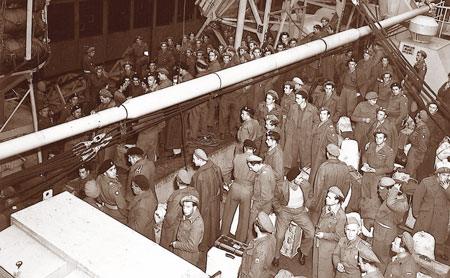
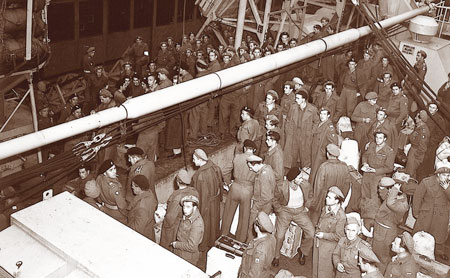
The Polish 2 Corps veterans accepted to the farm labour program arrived in Halifax, Canada, aboard the Sea Snipe, from Italy (Jaworska 209). The costs to bring in the Polish veterans amounted to $5.54 for clothing for each individual, $125,000 in transportation costs from Halifax for the first 2,876 Poles who came from Italy, and $20,000 in travel costs to their assigned farms. The provincial Departments of Agriculture shared these expenses with the federal Department of Labour. According to data from the Department of Labour, Alberta accepted 750 Polish vets from that group.
6. The Anders Army Veterans and a German POW Camp 133 in Lethbridge, Alberta
In November 1946, upon arrival in Lethbridge, Alberta, 300 Polish war veterans were housed in a still-functioning Camp 133 for the German POWs (Jaworska 270). They then learned that they had been brought to Canada to replace the German POWs working on farms during the war. The last transport to Europe of the German prisoners of war took place on December 22, 1946, when eight hundred of them travelled from Lethbridge to Halifax and later to Europe. From mid-November to the end of December 1946, POW Camp 133 in Lethbridge housed 300 Polish veterans of World War II and more than twice as many German prisoners of war. Both sides wore their military uniforms and war medals.
Soon after their arrival, WWII veterans of the Anders Army were assigned to farms on which they were to work. The Polish veterans were often allocated to work for the same farmers the German prisoners of war worked for during the war. Polish veterans were to receive $45.00 for a month of farm work. These were the same wage as the German POWs received during the war. Because of that, the Polish veterans brought to Alberta felt offended.
In addition to the issue of low wages, further problems were caused by work clothing given to the Polish veterans, causing further offence and assimilation problems. The Canadian authorities provided Polish veterans with agricultural clothes that had been intended for German POWs or, in some cases, had been used by them while working in Canada. The clothing had a red circle sewn on the back to prevent the German POWs from escaping (Thornton, 1989, p. 243). Hence, it was not surprising that some Canadians seeing Poles in such ‘uniform’ often confused them with the previous German prisoners who had worked on the farms while in the POW camp. Many Polish veterans opted to use their military uniforms instead. Considering the conditions under which the Polish veterans participated in the two-year-long farm service, they felt more like prisoners of war than immigrants.
The veterans working on farms in Alberta reported that farmers often underpaid them or refused to pay them for their work. Also, the veterans reported that they were expected to work on more than one farm. Some reported that the farmers left them alone for several months, tasking them with taking care of the farm. In addition, upon return, the farmer refused to pay for the work on the farm.
Also, in Alberta, the ex-servicemen reported poor accommodation conditions inadequate for the harsh Canadian winter while living and working on the farms. Many lived in substandard accommodations such as chicken coops or poorly built and uninsulated farm sheds with leaking roofs.
Other Polish veterans reported not being provided with enough food and experiencing malnutrition while working on farms. Others reported that they were expected to repay for the broken work tools. Many Polish veterans spent months in isolation, living on remote farms with limited contact with the outside world. They did not have access to any media and were not informed about their rights. The Polish war veterans also reported that the immigration offices did not help them deal with such abuses, requesting they continue working on such farms. In some cases, transfers between farms were allowed after fulfilling one year of work.
Mr Władysław Niewiński, a Polish 2 Corps veteran, who fought for Monte Cassino, described the Polish veterans’ arrival in Lethbridge, “Even though we came to a free country, we came to a camp, but this time to a German camp”. Niewiński recalled it was frigid upon arrival at Camp 133 in Lethbridge, prompting him to look for wood or coal to warm up the room. He continued, “Farmers started arriving to pick up soldiers. They were picking us up like piglets, like slaves” (Jaworska 171).
Polish war veterans arriving in Canada were not treated as one would expect Allied war veterans deserved it. The Canadian government did not consider that the Canadian immigration policies of bringing Polish war veterans to replace the German POWs who had worked on farms during the war would be demeaning to them. Both groups were treated based on their economic contribution and, as such, were equated. No efforts were made to ensure that Polish ex-soldiers were treated as Allies upon arrival.
7. The Results of the Farm Work Program
In September 1948, almost two years after 4,527 Polish veterans arrived in Canada, the Department of Labor reported that 4,081 of them were employed on farms. It also stated that 91 Polish veterans were missing, 14 died, 18 were hospitalised, 12 were in mental institutions, and 16 were in Brandon Sanatorium. Thirteen of them had left Canada, and 18 were allowed to establish their farms. After the expiry of the two-year contracts, Polish veterans received landed immigration permits, allowing them to leave the farms. Most Polish veterans moved to the cities, looking for employment. Many of them took courses while in Italy, where they learned such trades as electricians, mechanics, or heavy-duty truck drivers.
author: Aldona Jaworska, Canada
The Second Polish Army Corps and its Veterans in Alberta includes excerpts from the 2014 MA Master’s thesis Diaspora, Identity and the Canadian Media: The Case of the Second Polish Corps in World War Two and the Re-settlement of its Veterans in Alberta (Jaworska); the 2019 book Polish War Veterans in Alberta: The Last Four Stories by Aldona Jaworska (Jaworska); and the 2021 MFA Master’s thesis Remember Me: A Theatrical Examination of the Situation of Polish World War II Veterans (Jaworska).
Bibliography:
Anders, Władysław. An Army in Exile. London: Macmillan & CO Ltd., 1949.
Jaworska, Aldona. “Diaspora, Identity and the Canadian Media: The Case of the Second Polish Corps in World War Two and the Re-settlement of its Veterans in Alberta.” Calgary, 2014.
—. Polish War Veterans in Alberta: The Last Four Stories. Edmonton: University of Alberta Press, 2019. 15 July 2020.
—. “Remember Me: A Theatrical Examination of the Situation of Polish World War II Veterans (Unpublished master’s thesis). University of Calgary, Calgary, AB.” 2021. <http://hdl.handle.net/1880/113997>.
Office of the Historian. “Foreign Relations of the United States: Diplomatic Papers, The Conference of Berlin (The Potsdam Conference), 1945, Volume II. Statement on the Polish Question.” 21 July 1945. The Office of the Historian. 30 July 2022. <https://history.state.gov/historicaldocuments/frus1945Berlinv02/d1131>.
The Office of the Historian. The USA. “Conference Documents and Supplementary Papers.” 21 July 1945. Foreign Relations of the United States: Diplomatic papers, The Conference of Berlin (The Potsdam Conference), 1945, Volume II. 31 July 2022. <https://history.state.gov/historicaldocuments/frus1945Berlinv02/pg_1124>.
The Times. “British Anxiety over Polish Elections. Text of Latest Note.” The Times 30 November 1946: 1-10. <https://www.thetimes.co.uk/tto/archive/frame/article/1946-11-30/3/8.html>.
—. “British Plans for Polish Forces Oversea. Transfer of Civilian to Life as Soon as Possible.” The Times 23 May 1946: 1-10. <https://www.thetimes.co.uk/tto/archive/frame/article/1946-05-23/4/12.html>.
—. “Gen Anders Army Return to Civil Life. Polish Complaint; Military Guise; Outside Supervision.” The Times 23 August 1946: 1-10. <https://www.thetimes.co.uk/tto/archive/frame/article/1946-08-23/4/6.html>.
—. “Polish Resettlement Corps’ Members to be Deprived of Citizenship.” The Times 13 September 1946: 1-8. 26 July 2022. <https://www.thetimes.co.uk/tto/archive/frame/article/1946-09-13/3/13.html>.
—. “Polish Soldiers in Britain. Unsettled Dispute with Warsaw. Lack of Cooperation. From our Diplomatic Correspondent.” The Times 9 November 1946: 1-10. <https://www.thetimes.co.uk/tto/archive/frame/article/1946-11-09/4/10.html>.
—. “Polish Soldiers’ Status. Resettlement Corps and Law.” The Times 4 September 1946: 1-10. <https://www.thetimes.co.uk/tto/archive/frame/article/1946-09-04/3/7.html>.
—. “Polish Troops in Italy. Return to Britain Soon.” The Times 20 May 1946: 1-8. <https://www.thetimes.co.uk/tto/archive/frame/article/1946-05-20/4/21.html>.
—. “Resettlement of Poles in Britain. From Our Labour Correspondent.” The Times 23 May 1946: 1-10. <https://www.thetimes.co.uk/tto/archive/frame/article/1946-05-23/4/12.html>.
—. “Resettlement of Poles. Functions of New Corps.” The Times 31 August 1946: 1-8. <https://www.thetimes.co.uk/tto/archive/frame/article/1946-08-31/3/8.html>.
Thornton, Martin. “Domestic and International Dimensions of Canadian Foreign Policy 1943-1948: The Resettlement in Canada of Ex-Servicemen of The Second Polish Army Corps. (Order No. U048335). Available from ProQuest Dissertations & Theses Global. (301437268).” London School of Economics and Political Science, 1990.
Thornton, M. (1989). The resettlement in Canada of 4,527 Polish ex-servicemen, 1946-47. Immigrants & Minorities, 235-251.