



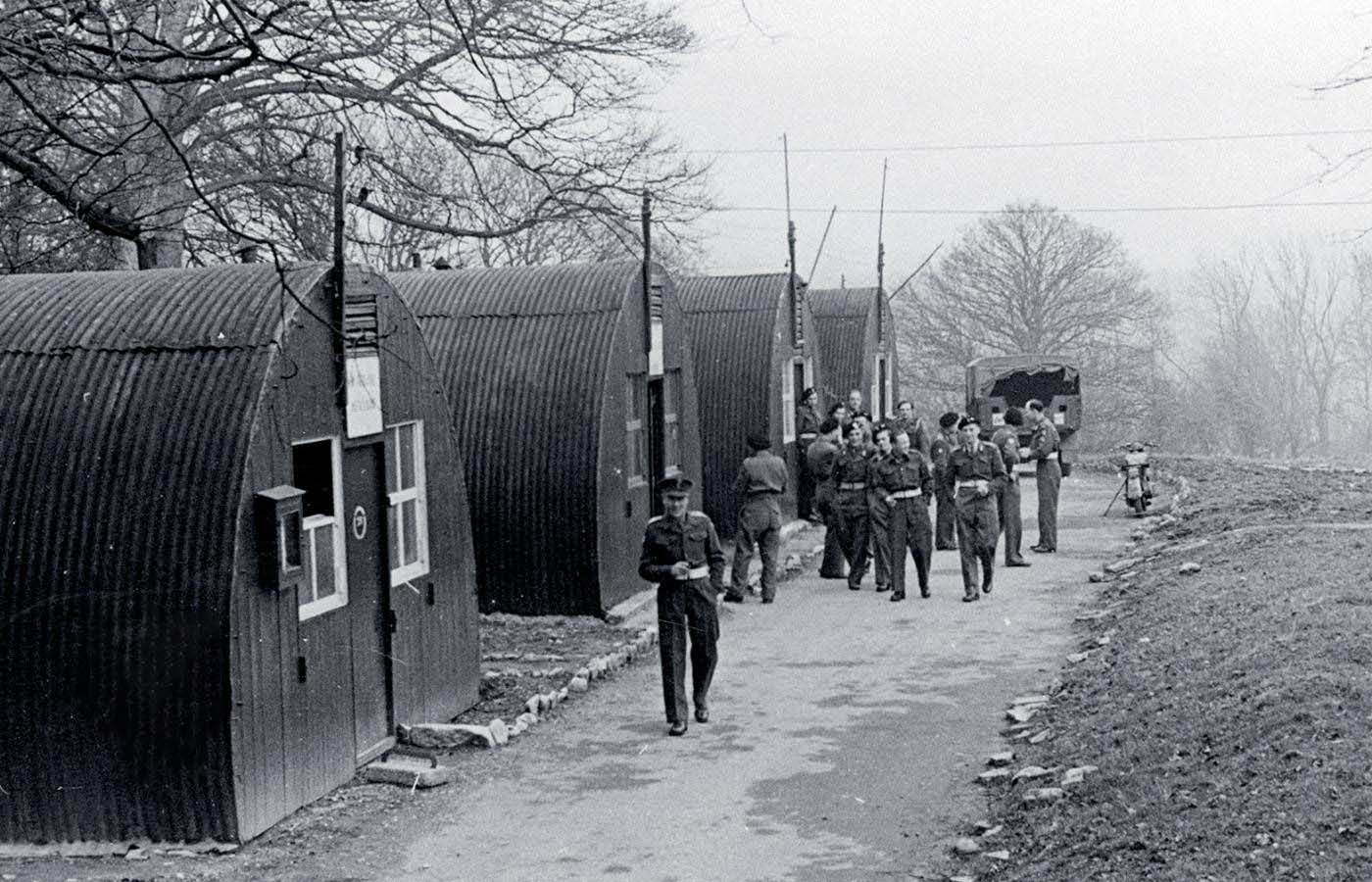
Until World War II, the area of Great Britain was not a target of wide Polish emigration. It was only the defeat of France in 1940 that made the area of the British Isles a mainstay of the Polish Army troops and the legal Polish authorities in exile. It was here that the 1st Polish Corps, the 1st Armored Division of General Maczek and the 1st Independent Parachute Brigade of General Sosabowski were formed. Here, Polish airmen became famous in the Battle of Britain, and the Polish Navy achieved a number of combat successes alongside the Allies. Due to the tragic consequences for Poland and Poles of the decisions made during the Yalta and Potsdam conferences, the Polish Armed Forces in the West were not allowed to return to their homeland. In addition, after the war, many tens of thousands of Polish civilian refugees remained in the West after the war, fearing to return to the dependent on the Soviet Union communist Poland. By the decision of the British authorities, the entirety of the Polish troops was on their territory by 1946, including the soldiers of the 2nd Polish Corps.
As the overwhelming majority of Polish soldiers decided to remain in exile, His Majesty’s Government prepared the Polish Resettlement Act, which resulted in the establishment of the Polish Resettlement Corps in 1946. It was to help Polish soldiers acquire the necessary professional qualifications and facilitate the transition to civilian life. It was also on the initiative of the British authorities that the dominions of the British Empire, such as Canada and Australia, decided to admit thousands of Polish veterans of the Second World War. It was also from here that Polish soldiers continued to emigrate to the USA and Argentina in the following years. From here, some of them also returned to Poland.
However, it is estimated that of the 250,000 soldiers of the Polish Armed Forces in the West in 1945, many of them remained in Great Britain. In the period of July-October 1946, soldiers of Polish 2nd Corps, transferred here from Italy, reached the British Isles. Initially, together with their mother units, they were located in military camps scattered throughout the territory of England and Scotland – in the areas of various local British commands. And so, most of the units of the 3rd Carpathian Rifle Division and the 14th Wielkopolska Armored Brigade of the 2nd Corps were deployed in camps in the Eastern Command District, the 5th Kresowa Infantry Division – west of London (Southern Command), soldiers of the 2nd Warsaw Armored Division – in the Northern Command District and units of the 2nd Army Artillery Group – in the Scottish Command District. Here, many Polish soldiers joined the Polish Resettlement Corps, which was created on the basis of King George VI’s “Royal Warrant” of June 24, 1946, while the relevant act was passed as the “Polish Resettlement Act, 1947” only at the beginning of the next year. Polish Resettlement Corps existed until 1949, and its Inspector General was appointed General Stanisław Kopański, former commander of the Independent Carpathian Rifle Brigade and the 3rd Carpathian Rifle Division of the Polish 2nd Corps.
The 2nd Corps itself was officially disbanded in 1947. The symbolic date of the demobilization of the units of the Polish Armed Forces in the West is July 10, 1947, when the banners of the Polish troops, including the 2nd Corps, were deposited at the Institute of Gen. Sikorski in London. Then all Polish soldiers, after demobilization, began civilian life. Those, whose family members were in camps for Polish refugees in Africa, the Middle East, India, New Zealand or Mexico, as well as war refugee camps in Germany, thanks to the efforts of Polish authorities in exile and British authorities mostly reunioned until the end of the 1940s with their parents, siblings, wives or children. Many of them lived for a long time in special refugee camps – resettlement camps. Until the early 1950s, lone soldiers often lived in specially designed hostels or rented flats together. For few years after the war, some soldiers were still treated in hospitals. The veterans of the 2nd Corps especially cared for war invalids and bed-ridden colleagues.
The fact that such a large number of Poles found themselves in Great Britain, in a country whose language many of them did not know well, because it was not taught before the war in Poland, a country struggling with major economic problems, meant that in order to cope with this difficult situation, separation from relatives in Poland, from 1945 military self-help was developing rapidly. As a result, it was in Great Britain that the largest veterans’ association of former soldiers of the Polish Armed Forces in the West was created – the Association of Polish Combatants – Stowarzyszenie Polskich Kombatantów (SPK). It took place at the Congress in London on May 23-24, 1946. Its branches were quickly established all over the world – in countries, where Polish soldiers had found themselves. On December 17, 1946, the establishment of the UK branch of the SPK was officially approved.
In the British Isles, among the former Polish soldiers, including the 2nd Corps, the majority of people (mainly men) were 20-40 years of age. After the liquidation of Polish Resettlement Corps and the cessation of paying them military pay, all of them had to find themselves in a difficult situation. Often educated people (including Polish senior officers) were forced to work below their qualifications, often in manual labor. From 1948, the greatest number of Poles worked in construction, agriculture, coal mining and the textile industry. Due to economic reasons, many families at the turn of the 1940’s and 1950’s decided to emigrate further, especially to the USA.
Polish veterans, apart from material matters, attached great importance to the active life of the Polish community in Great Britain, to cultivating national traditions, as well as to further struggle for independence by Poland, which was then under Soviet domination. SPK circles in the largest Polish agglomerations in Great Britain were developing dynamically. Attempts were made to purchase real estate and create Domy Kombatanta (Veterans’ Centres), Polish Roman Catholic parishes. They knew how important is to preserve Polish language, especially when they started families and their first descendants were born. It was on the initiative of former soldiers that the majority of Polish Saturday schools were created (at the SPK clubs or within the framework of the Polish Educational Society – Polska Macierz Szkolna, established in 1953 on the initiative of General Anders), libraries, club rooms, as well as artistic groups (orchestras, choirs, dance groups, theaters) or sports clubs (in particular football, volleyball and basketball), which also involved the younger generation in the activities of the Polish diaspora.
The soldiers supported the creation and development of Polish scout teams, and published numerous publications and magazines. They also remembered about patriotic celebrations and national holidays, in particular May 3 and the Soldier’s Day. On May 16, 1954, for example, at the Albert Hall in London, the 10th anniversary of the Battle of Monte Cassino was solemnly celebrated with the participation of the former commander of the British 8th Army, General Sir Oliver Leese and General Władysław Anders. Then the delegation of veterans went to Italy to the Monte Cassino cemetery. In 1966, veterans actively participated in the celebrations of the Millennium of the Polish State, including the several thousandth celebration on May 22, 1966 at the White City Stadium in London. In 1970, with deep sadness, the soldiers heard about death of General Anders, also paying tribute to him at the funeral in Monte Cassino. On September 18, 1976, the Katyn Monument was officially unveiled at the Gunnesbury Cemetery in London. An important experience for many veterans was the pilgrimage to Italy in May 1979 with the meeting with the Polish Pope – John Paul II. Veterans were also very active in helping their Poles in their homeland after the declaration of martial law in Poland by the communist authorities in 1981, as well as in the overthrow of communism and fully free elections in 1990.
They also remembered about their colleagues who returned to Poland, supporting them with parcels, and organizing protests of many thousands in the streets of London, for example in the protest after the massacre of workers in Poznań in 1956 or in Gdańsk in 1970. It was only after 1956 that visits of some family members from Poland were possible, some of them remained in exile.
The graves of deceased colleagues were also cared for, nursing homes were created, organizations were established to associate soldiers from individual units of the 2nd Corps, such as the Carpathian Union of former 3rd Carpathian Rifle Division, which exists to this day.
London, as the seat of Polish immigration authorities and the largest concentration of post-war Polish emigration, became the center of veteran life, as well as an important center for documenting and commemorating the history of Poles’ contribution on various fronts of World War II. This also applied to the 2nd Corps, the valuable and extensive documentation of which was, along with the banners and other military memorabilia of the Polish Armed Forces in the West, in the collections of the Polish Institute and the General W. Sikorski Museum. It is in London that Polish parishes are dynamically operating, in whose churches there are many commemorative plaques dedicated to Polish soldiers, including the 2nd Corps. Here, on the initiative of Polish emigrants and Polish combatants, the Polish Social and Cultural Center (POSK) was established in the 1970s, which is an important center of Polish diaspora activity in the capital of Great Britain, together with the library.
Evidence of the extensive activity of Polish combatants, including those from the Polish 2nd Corps, is the fact that in 1949 there were 202 SPK branches, in 1980 still over 100 SPK branches, and in 1992 87 ones throughout Great Britain. The activity of Polish veterans was particularly active in the following regions of the British Isles:
Area 1 – Blackpool, Blackburn, Preston, Chorley, Lancaster, Liverpool
Area 2 – Leeds, Keighley, Halifax, Huddersfield, Bradford
Area 3 – Manchester, Todmorden, Northwich, Penrhos, Ashton-under-Lyne, Oldham, Rochdale, Bury, Merseyside, Wrexham-Penley, Crewe
Area 4 – Chesterfield, Lincoln, Sheffield, Doncaster, Rotherham, Scunthorpe
Area 5 – Loughborough, Mansfield, Leicester, Derby, Nottingham
Area 6 – Telford, Kidderminster, Birmingham, Worcester, Wolverhampton, Stafford, Stoke-on-Trent, Rugby, Coventry
Area 7 – Ipswich, Peterborough, Wellingborough, Cambridge, Bedford, Witham, Luton
Area 8 – Cheltenham, Bristol, Bridgewater, Dursley, Trowbridge, Cardiff
Area 9 – Amersham, Slough, Aylesbury, High Wycombe, Swindon, Oxford, Reading
Area 10 – Edinburgh, Aberdeen, Perth, Falkirk, Kirkcaldy, Dundee, Glasgow
Area 11 – London, Goldaming-Horsham, Brighton / Hove, Southhampton.
The fall of communism in Poland in 1989 and the transfer of the insignia of power by the Government in Exile to Poland made the veterans of the 2nd Corps actively cooperate with their homeland, and since then joint conventions of combatants and celebrations in Poland and abroad are possible. As the last veterans of the 2nd Corps depart for eternal guarding, memory about them, care for their legacy and graves are taken over by their descendants and younger Poles from Poland and Great Britain.
Author: Aneta Hoffmann, Warsaw, Poland